

For many implant patients, a defining moment occurs weeks or months after the procedure. It happens quietly, perhaps at a restaurant during a conversation. They take a bite of bread or fruit and suddenly realize they haven’t thought about their implant at all during the meal. No conscious adjustments or careful chewing, just eating naturally and comfortably, as they did before losing the tooth.
That moment is the most honest answer to the question this blog is asking. But it deserves a fuller explanation because we know the journey of individuals getting a dental implant in Trimurti Nagar.
What the Implant Feels Like in the Beginning?
Let's be straightforward about the early days, because honesty is the foundation of any useful implant conversation.
Immediately after the implant placement procedure, you will be aware of it. The area will be tendered. There will be some swelling, some sensitivity, and a general sense that something new is present in your jaw. This is entirely normal and entirely temporary. The implant has just been surgically placed into the bone, and your body is doing exactly what it should, initiating the healing response that will eventually make this foreign titanium post feel like an indistinguishable part of you.
Most patients at Om Dental Clinic describe the post-procedure discomfort as manageable, comparable to a tooth extraction, not significantly worse. It responds well to the prescribed pain relief and settles significantly within the first three to five days. By the end of the first week, the acute tenderness has usually passed, and the implant simply feels like a healing site, slightly sensitive but not actively painful.
During this phase, you will eat carefully, with soft foods, cool temperatures, and chewing on the opposite side. This is not a permanent state; it is a brief, necessary courtesy to a healing jaw.
The Osseointegration Phase: When the Real Magic Happens?
The weeks and months that follow implant placement are when the most remarkable biological process in modern dentistry takes place, and it happens entirely without your involvement.
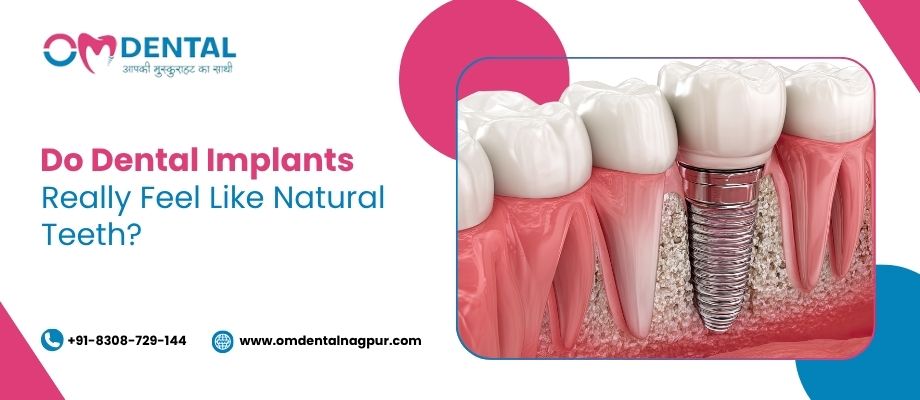
Osseointegration is the process by which the titanium implant fuses with the surrounding jawbone. The bone cells grow around and into the microscopic surface texture of the implant post, integrating it so completely that the implant becomes structurally indistinguishable from a natural tooth root. It is not merely held in place by the bone; it becomes part of it.
This process takes three to six months, depending on the individual patient, the implant location, and the density of the surrounding bone. During this time, patients receiving dental implant treatment in Swawlambi Nagar at Om Dental Clinic are monitored carefully at regular intervals, because this phase, while passive, is the foundation of everything that follows.
What patients notice during osseointegration is a gradual and steady increase in the implant's sense of solidity. In the early weeks, it feels stable but slightly unfamiliar, like a new presence in your jaw that you're still getting acquainted with. As the weeks pass and integration progresses, that unfamiliarity fades. The implant stops feeling like something that has been placed there and starts feeling like something that belongs there.
The Final Crown: The Moment It Becomes a Tooth
When osseointegration is confirmed and the permanent crown is fitted, something shifts noticeably for most patients.
The crown is custom-crafted, shaped precisely to your bite, matched to the colour of your surrounding teeth, and contoured to sit naturally against the gum line. It is not a generic tooth dropped into a gap. It is a tooth designed specifically for your mouth, your jaw, and your smile.
When it is fitted and the bite is adjusted, most patients report an immediate sense of completeness. The gap that has been present, sometimes for months during treatment, sometimes for years before the decision to get an implant was made, is simply gone. Replaced not by a compromise, but by something that looks, sits, and functions like it was always there.
Biting and chewing pressure is transmitted through the crown, through the implant post, and directly into the jawbone, exactly as it would be through a natural tooth root. This is the detail that distinguishes a dental implant from every other tooth replacement option. Dentures rest on the gum surface. Bridges distribute force across adjacent teeth. Only an implant replicates the direct, root-to-bone force transmission of a natural tooth, which is what makes the chewing experience feel genuinely real.
What Implants Do and Don't Replicate?
Honesty matters here, and Om Dental Clinic believes in giving patients the complete picture.
Implants replicate the function of natural teeth extraordinarily well. The stability, the biting force, the ability to eat anything without restriction, the way the tooth sits in the gum line, all of these are matched so closely that most patients cannot distinguish the implant from their natural teeth by function alone.
There are two areas where a subtle difference sometimes remains. The first is temperature sensitivity. Natural teeth contain living pulp tissue that responds to hot and cold. An implant crown is made of an inert material, ceramic or zirconia, and does not transmit that thermal sensation. For most patients, this is not a loss they notice in daily life. For some, particularly in the early months, the absence of that sensation is occasionally perceptible.
The second is the periodontal ligament. Natural teeth are not rigidly anchored to bone; they are suspended by a thin, elastic ligament that allows a tiny degree of natural flex and provides sensory feedback during chewing. Implants integrate directly with bone without this ligament, which means the subtle micro-movement of a natural tooth is not replicated. Again, this is something most patients never consciously notice, but it is worth naming honestly.
Everything else, appearance, stability, function, confidence, comfort over time, is replicated so completely that the question patients most commonly ask after their implant has fully settled is why they waited so long.
The Moment You Forget
For patients who have chosen dental implant treatment in Swawlambi Nagar at Om Dental Clinic, that moment of forgetting, the mid-meal realisation that the implant hasn't crossed their mind, typically arrives somewhere between three and six months after the final crown is fitted.
It arrives differently for everyone. For some, it's biting into something crunchy. For others, it's laughing unselfconsciously at a dinner table. For others, it's a photograph where they smiled without thinking about it first.
But it arrives. For almost every patient who completes the process and follows through with their care, it arrives.
And when it does, it answers the question this blog began with more completely than any clinical explanation could. Because the best evidence that a dental implant feels like a natural tooth is the moment you stop being able to tell the difference.
Is It the Right Choice for You?
Whether an implant is the right solution depends on your specific clinical situation, bone volume, overall health, the location of the missing tooth, and long-term dental goals. What Om Dental Clinic can tell you is that for patients who are suitable candidates for a dental implant in Trimurti Nagar.
A consultation is the only way to know whether you're a candidate, and it begins with a conversation, not a commitment. Come with your questions. Leave with a clear, honest picture of what is possible for your smile.